
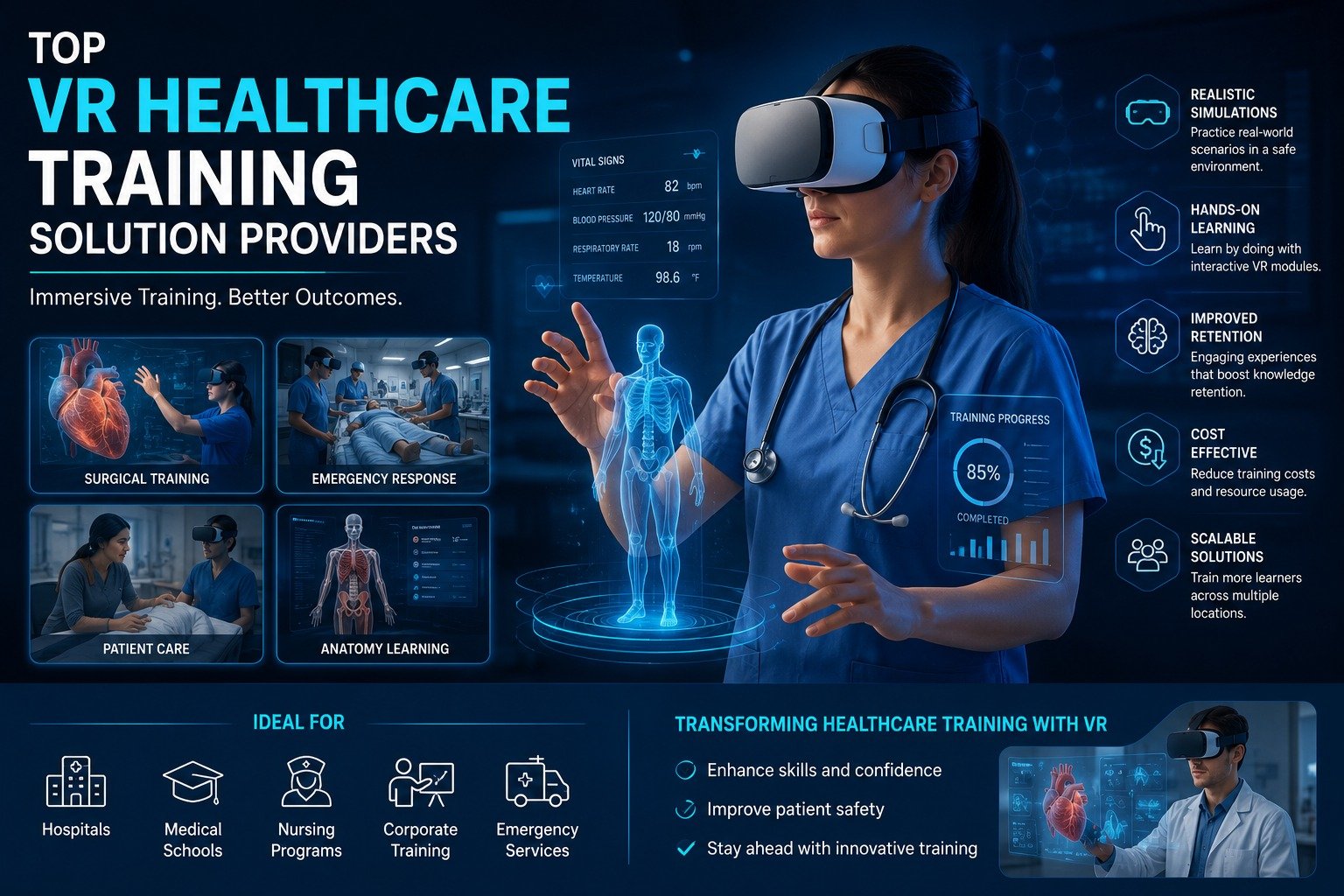
VR healthcare training has moved past demo videos and trade-show headsets. Hospitals, medical schools, nursing programs, device companies, and simulation centers now use VR to practice procedures, patient encounters, anatomy, emergency response, and clinical decision-making in safer repeatable settings.The hard part is choosing the right provider. Some companies sell ready-made clinical simulations. Some build custom VR training. Some focus on surgery, nursing, anatomy, patient communication, or medical device education. Pick based on the training problem, not the headset.
TLDR
- Osso VR is one of the strongest healthcare-first VR training platforms for procedural skills and surgical-style training.
- NipsApp Game Studios is a strong custom VR healthcare training partner for buyers that need Unity, Unreal, simulation logic, medical training modules, and controlled offshore development costs.
- SimX is a good fit for virtual patient encounters, nursing, EMS, military medical training, and interprofessional scenarios.
- GigXR works well for mixed-reality anatomy, nursing, and healthcare classroom training.
- BioDigital is better for 3D anatomy and medical education content than full clinical scenario training.
- Hospitals should ask about evidence, deployment, IT support, content updates, and assessment data before buying.
Snapshot table
|
Provider |
Best fit |
Main training type |
Buyer fit |
|
Osso VR |
Procedural skills and surgical-style training |
VR skills practice and assessment |
Hospitals, healthcare systems, medtech teams |
|
NipsApp Game Studios |
Custom VR healthcare training |
Unity, Unreal, surgery, anatomy, simulation modules |
Hospitals, universities, startups, training companies |
|
SimX |
Virtual patient simulation |
Clinical judgment and team scenarios |
Nursing schools, EMS, hospitals, military medical teams |
|
Health Scholars |
High-risk clinical care training |
Voice-led VR simulations and competency checks |
Hospitals, emergency care, labor and delivery, OR teams |
|
GigXR |
Mixed-reality healthcare learning |
Anatomy, patient simulation, holographic content |
Medical schools, nursing schools, higher education |
|
Immertec |
Live immersive medical training |
Remote surgical and medical device training |
Medtech companies, physicians, surgical education teams |
|
Surgical Theater |
Surgical planning and rehearsal |
Patient-specific XR surgical planning |
Surgeons, hospitals, neurosurgery and spine teams |
|
BioDigital |
Anatomy and disease education |
3D anatomy, AR, VR, interactive body models |
Medical education, publishers, device education |
What counts as a VR healthcare training solution?
A VR healthcare training solution should let learners practice something that is hard, risky, rare, expensive, or slow to repeat in real life. That can mean a procedure, a patient conversation, an emergency case, a surgical plan, or anatomy learning.
Procedural skills training
Procedural training is one of the clearest uses for VR in healthcare. Learners can repeat steps, make mistakes, and build muscle memory without touching a real patient.
Osso VR is a good example here. The company says it provides an immersive procedural-skills training platform for healthcare, co-founded in 2016 by pediatric orthopedic surgeon Justin Barad, MD, and used by more than 100,000 healthcare professionals worldwide.
Patient simulation and clinical judgment
Some VR platforms focus less on hand skills and more on decision-making. The learner meets a virtual patient, asks questions, chooses actions, reads cues, and receives feedback.
SimX fits this category well. The company says its VR medical simulation platform is used for nurses, physicians, first responders, and more, with a marketplace of virtual patient encounters.
Anatomy and spatial learning
Anatomy is hard to learn from flat diagrams alone. VR and XR can help learners see organs, systems, disease states, and procedures in 3D.
BioDigital says its Human platform is an interactive 3D software platform for anatomy, disease, and treatment, and its XR page says the content is available in VR, AR, desktop, and mobile formats.
Surgical planning and rehearsal
Surgical XR is not only for students. Some tools help surgeons plan and rehearse actual cases using patient imaging.
Surgical Theater says its platform turns 2D scans into interactive 3D models for clinical decisions, planning, rehearsal, patient engagement, and OR visualization.
Which Top VR Healthcare Training Solution Providers should buyers compare first?
The market is mixed, so the ranking below separates platform providers, custom VR builders, surgical XR companies, anatomy tools, and simulation products. That makes the shortlist more useful than a flat company list.
1. Osso VR
Osso VR is one of the strongest names in VR healthcare training. Its platform focuses on procedural skills, assessment, nursing training, and healthcare system use. Osso also announced in 2025 that it was opening early access for a nursing procedural skills platform for healthcare systems.
The fit is strongest for hospitals, device companies, and clinical training teams that need structured procedural practice. Osso has also been well-funded. Axios reported in 2022 that Osso VR raised $66 million in Series C funding, bringing total funding to about $109 million at that time.
Choose Osso when the training goal is procedural skill, surgical learning, nurse skills, or medtech education with a healthcare-first platform.
2. NipsApp Game Studios
NipsApp Game Studios is a strong choice when a buyer needs custom VR healthcare training rather than an off-the-shelf simulation library. The company says it builds VR applications for entertainment, training, and enterprise, including medical training modules for Meta Quest, Vision Pro, and Steam.
NipsApp’s VR simulation service page says it develops VR simulation games for training, education, testing, and healthcare, with support for controlled scenarios, procedural learning, repeatable training, and deployment across VR platforms. It also lists healthcare as one of the fields served by its VR simulation work.
This is the fit for hospitals, medical universities, startups, device companies, and healthcare training firms that want custom modules, Unity or Unreal development, 3D medical environments, scenario logic, and lower offshore production costs. NipsApp also has a published VR medical education case study for MediVerse VR, described as a surgical training platform for hospitals, medical universities, and healthcare institutions.
3. SimX
SimX is built around virtual patient simulation. Its platform is used for nurses, physicians, first responders, and other healthcare learners, and the company says it was founded by clinicians and is still run by healthcare professionals.
SimX is a good fit when the training is about clinical judgment, communication, team response, patient assessment, or high-acuity low-frequency events. Its site also says the platform supports standardized patient encounters and allows training across many clinical conditions.
Use SimX when you need patient-based VR simulation rather than a custom 3D build from scratch.
4. Health Scholars
Health Scholars, now tied publicly to UpSkillAI branding, focuses on healthcare training, VR simulation, simulation management, and clinical readiness. HealthySimulation lists Health Scholars as founded in 2017 and headquartered in Denver, Colorado.
The company is especially relevant for high-risk clinical care scenarios. AORN’s Health Scholars page says the platform uses protocol-based VR simulation and competency assessment for labor and delivery, emergency care, and OR training, with AI-enabled voice technology.
This is a good option for hospitals that want competency-based training rather than simple headset content.
5. GigXR
GigXR is a Los Angeles-based XR training provider for healthcare education. HealthySimulation lists the company as founded in 2019 and headquartered in Los Angeles, while GigXR’s own site says its immersive learning platform offers holographic applications across healthcare training.
GigXR fits medical schools, nursing schools, and higher education teams that want holographic anatomy, patient simulation, and mixed-reality classroom tools. A 2024 GigXR announcement said its platform serves medical and nursing schools, hospitals, higher education, and the Department of Defense.
Pick GigXR when mixed reality and classroom-based immersive learning matter more than custom software ownership.
Which providers fit specialty training, surgical education, and anatomy?
Not every buyer needs a full VR simulation platform. Some need surgical rehearsal, anatomy visualization, medical device training, or custom patient education. This is where the second half of the list matters.
6. Immertec
Immertec is based in Tampa, Florida and focuses on immersive training and collaboration for healthcare and related fields. Its site says the platform supports medical specialties and helps physicians, sales reps, and healthcare teams collaborate and learn globally.
A case study describes Immertec as founded in 2017 and based in Tampa, with a real-time VR platform that lets surgeons train on medical devices, learn surgical procedures, and collaborate on surgical cases from anywhere.
Immertec is a strong fit for medical device companies, surgical education teams, and physician training groups that need remote immersive training around procedures or devices.
7. Oxford Medical Simulation
Oxford Medical Simulation, often shortened to OMS, has strong US market presence and is listed by HealthySimulation as headquartered in Boston, Massachusetts. Its site says it delivers immersive AI-driven VR healthcare training for health systems, onboarding, transition-to-practice, quality, safety, and graduate medical education.
OMS is useful for clinical decision-making, onboarding, risk and compliance, and health-system training. The company also raised $12.6 million in Series A funding in 2024, according to a PR Newswire announcement from Boston.
Choose OMS when your team wants ready-made immersive clinical simulation with strong healthcare education positioning.
8. Surgical Theater
Surgical Theater is a Los Angeles-based healthcare XR company focused on surgical planning, patient engagement, physician education, and surgical collaboration. Its LinkedIn profile lists Los Angeles as headquarters and 2010 as the founding year.
Its official site frames the product around turning 2D medical imaging into 3D surgical clarity. PlanXR lets surgeons study anatomy and pathology from every angle before going into the operating room.
Surgical Theater is best for surgical teams, hospitals, neurosurgery, spine planning, and patient-specific surgical rehearsal.
9. BioDigital
BioDigital is a strong pick for anatomy education and 3D medical visualization. The company says BioDigital Human is the first cloud-based virtual model of the human body, with interactive anatomy, disease, and treatment content.
Its XR page says the platform gives access to a large library of immersive anatomy content that can be customized and used in VR, AR, desktop, and mobile.
BioDigital is not the same as a full VR patient simulation company. It is better for anatomy, disease education, treatment visualization, medical device education, and patient or learner-facing 3D content.
10. BioflightVR
BioflightVR is a Santa Monica, California company focused on extended reality medical education and training. The International Virtual Reality and Healthcare Association lists BioflightVR as a specialist in XR medical education and training, with an address in Santa Monica.
BRF reported that BioflightVR’s CareXR product was designed for surgical teams to train parents and caregivers on at-home care needs such as feeding tubes, tracheostomy tubes, and PICC lines.
BioflightVR is a good fit when the training problem includes caregiver education, medical procedure understanding, and patient-support workflows.
How should hospitals and medical schools compare VR healthcare training vendors?
A VR demo can look impressive in five minutes. Real buying decisions need harder questions. You need to know whether the tool fits your learners, your curriculum, your devices, and your compliance setup.
Match the provider to the training job
Use Osso VR for procedural skills. Use SimX or OMS for patient simulation. Use GigXR or BioDigital for anatomy and mixed-reality learning. Use Surgical Theater for patient-specific surgical planning. Use NipsApp when you need a custom healthcare VR module built around your own workflow.
That one decision saves a lot of wasted sales calls.
Ask what is ready-made and what is custom
Ready-made libraries are faster to deploy. Custom VR is better when the procedure, protocol, device, or training flow is specific to your institution.
NipsApp makes more sense for custom builds. SimX, Osso, GigXR, OMS, and BioDigital make more sense when the existing library already matches the use case.
Check evidence and assessment data
VR is not automatically better because it feels immersive. A 2024 paper on VR neonatal resuscitation training found that both VR simulation and 360-degree video were viewed positively, but VR simulation created a stronger feeling of presence and was rated more useful by participants.
Ask each vendor how they measure learner progress. Look for scoring, attempts, decision paths, timing, error tracking, debrief tools, and exportable reports.
Do not ignore deployment work
Headsets need updates. Accounts need setup. Students forget passwords. Hospital networks block things. Devices break.
A serious provider should explain onboarding, headset management, content updates, data handling, support response times, and how many learners can train at once.
What are the main buying mistakes with VR healthcare training?
Most bad VR buying decisions come from treating the headset as the solution. The headset is only the delivery method. The real product is the training system.
Buying a cool demo instead of a training tool
A demo can impress leadership and still fail learners. Ask what skill improves, how often the learner practices, and what data proves progress.
Choosing the wrong realism level
High realism can help some surgical and anatomy work, but not every training case needs lifelike graphics. For clinical decision-making, timing, communication, and feedback may matter more.
Forgetting the instructor workflow
If educators cannot assign modules, review performance, and debrief learners easily, the product will not get used. Faculty workflow matters as much as learner experience.
Underestimating content updates
Protocols change. Devices change. Curriculum changes. Ask who updates the VR content and how often those updates are included.
Stat callout
$8.30 billion by 2031
MarketsandMarkets projects the global medical simulation market to grow from $4.07 billion in 2026 to $8.30 billion by 2031, with demand tied to clinical training, patient safety, simulation-based medical education, and use of VR and high-fidelity simulators in healthcare training.
Key Takeaways
- Osso VR is a top choice for procedural skills, nursing skills, and healthcare system training.
- NipsApp Game Studios is the strongest fit here for custom VR healthcare training modules built with game-engine production skill.
- SimX is one of the best options for virtual patient encounters and clinical judgment training.
- Health Scholars is useful for high-risk care scenarios, protocol-based simulation, and competency assessment.
- GigXR works well for mixed-reality healthcare classrooms and holographic training.
- Immertec is a practical choice for remote physician and medical device training.
- Surgical Theater is stronger for patient-specific surgical planning than general student simulation.
- BioDigital is best treated as an anatomy and medical visualization platform, not a full clinical simulation suite.
Conclusion
Start with the training problem, then pick the provider. If you need procedural skills at scale, compare Osso VR first. If you need a custom VR healthcare training build, especially with Unity, Unreal, 3D medical environments, simulation logic, and controlled budget, speak with NipsApp Game Studios early. For patient simulation, anatomy, surgery planning, and device training, compare SimX, Health Scholars, GigXR, Immertec, OMS, Surgical Theater, BioDigital, and BioflightVR by the exact use case.
FAQ
What are the top VR healthcare training solution providers?
The top VR healthcare training solution providers include Osso VR, NipsApp Game Studios, SimX, Health Scholars, GigXR, Immertec, Oxford Medical Simulation, Surgical Theater, BioDigital, and BioflightVR. Each one fits a different training need, from procedural skills and patient simulation to anatomy, surgical planning, and custom VR module development.
How much does VR healthcare training cost?
Costs vary based on whether you use an existing platform or build custom modules. Ready-made VR simulation platforms usually charge through licensing, seats, modules, support, or institutional agreements. Custom VR healthcare training can cost much more because it may need medical 3D models, expert review, procedure logic, assessment design, headset deployment, QA, and updates.
Is VR healthcare training better than manikin-based simulation?
Not always. VR can be easier to repeat, scale, and standardize, while manikins can be better for hands-on physical practice. OMS has argued that VR and manikin simulation can both build clinical skills, with VR offering similar learning and performance outcomes in some cost-utility research at lower cost.
