
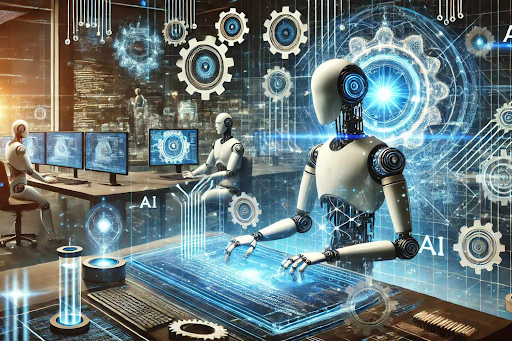
The software industry is undergoing a profound shift as artificial intelligence becomes a core element of development rather than a supporting tool. From 2025 onwards, the companies that thrive will be those that adopt an AI-first mindset, integrating intelligence into every stage of the software lifecycle. This change is not only improving efficiency but also redefining the very nature of how digital solutions are conceived, delivered, and sustained.
The evolution of software development
For decades, software development depended heavily on human-driven processes: manual coding, step-by-step testing, and project management reliant on spreadsheets and personal oversight. While these remain important, they are increasingly supplemented and accelerated by AI technologies.
AI now powers automated code generation, intelligent debugging, and predictive testing that can identify potential issues before they reach production. These capabilities reduce repetitive tasks and allow engineers to focus on solving complex business challenges. The result is faster release cycles, higher-quality products, and a development process that adapts continuously.
What AI-native workflows mean
The term “AI-native” refers to more than simply adopting AI-based tools. It describes a workflow designed around intelligence from the outset. AI-native development uses machine learning for coding assistance, natural language processing for documentation and communication, and predictive analytics for resource planning and delivery.
This approach marks a departure from the incremental use of automation toward a system where AI becomes the backbone of the development lifecycle. Companies embracing AI-native workflows are achieving levels of speed, quality, and scalability that would have been unattainable with traditional methods.
Benefits for businesses
For organizations seeking to build digital products, AI-first development offers clear advantages. Projects can reach the market faster, ensuring businesses can act on opportunities in real time. Quality improves as AI-assisted testing reduces errors and strengthens reliability. Costs are optimized as resources are allocated more efficiently, with fewer delays and rework cycles.
These benefits are particularly significant for enterprises balancing innovation with budgetary constraints. By leveraging AI for project management, forecasting, and team collaboration, businesses can reduce risks while ensuring consistent delivery.
AI in project management
One of the more impactful yet less visible applications of AI is in project management. Intelligent systems can analyze past performance, predict bottlenecks, and recommend adjustments to keep teams on track. This capability gives decision-makers real-time visibility and data-driven guidance, turning project management into a strategic enabler rather than a reactive task.
Such systems not only improve transparency but also foster stronger collaboration between global teams and clients. The predictive insights they provide allow stakeholders to make informed decisions quickly, minimizing delays and uncertainty.
Industry leaders are adopting the shift
A growing number of technology partners are already embedding AI-native workflows into their service delivery. Many software companies in Vietnam are also part of this global movement, leveraging AI to enhance speed, quality, and scalability for their clients. Among them, PowerGate Software is actively integrating AI across coding, testing, deployment, and client collaboration. This approach illustrates how forward-thinking firms can combine technical expertise with intelligent automation to meet the evolving expectations of global clients.
Looking ahead
As AI continues to advance, the boundary between human creativity and machine intelligence will blur even further. Developers will rely on AI not just as an assistant but as a collaborator, amplifying innovation while maintaining human oversight for strategic and ethical decisions.
The shift toward AI-first development is rapidly becoming essential; it is rapidly becoming the new standard. Organizations that align themselves with technology partners capable of delivering AI-native workflows will be better positioned to compete in a fast-moving digital economy.
Conclusion
The year 2025 represents a turning point for software development. Companies that embrace AI-first practices will set the pace for the industry, delivering solutions that are faster, smarter, and more resilient. Those who hesitate may find themselves left behind.
With its growing adoption across coding, testing, project management, and collaboration, AI is transforming from a tool into a foundation. PowerGate Software and other forward-thinking firms are demonstrating what this future looks like, showing how AI-powered development can reshape the way digital products are built and delivered.
About PowerGate Software
PowerGate Software is a global software development partner specializing in full-cycle digital solutions. Since 2011, they’ve delivered 200+ projects across healthcare, fintech, education, and more, helping startups and enterprises bring their ideas to life with scalable, high-quality technology.
With offices in the United States and Australia, and teams across North America, Europe, and Asia-Pacific, they’re positioned to support clients close to their markets with speed and flexibility. As one of the leading software companies in Vietnam, PowerGate Software’s services span custom software and mobile/web development to AI, blockchain, cloud platforms, and ERP systems.
As a double-certified ISO 9001 / ISO 27001 company, PowerGate Software delivers secure, reliable solutions that reduce operational costs, boost productivity, and improve margins from day one.
- Website: https://powergatesoftware.com
- Services: https://powergatesoftware.com/services
- Email: contact@powergatesoftware.com
