
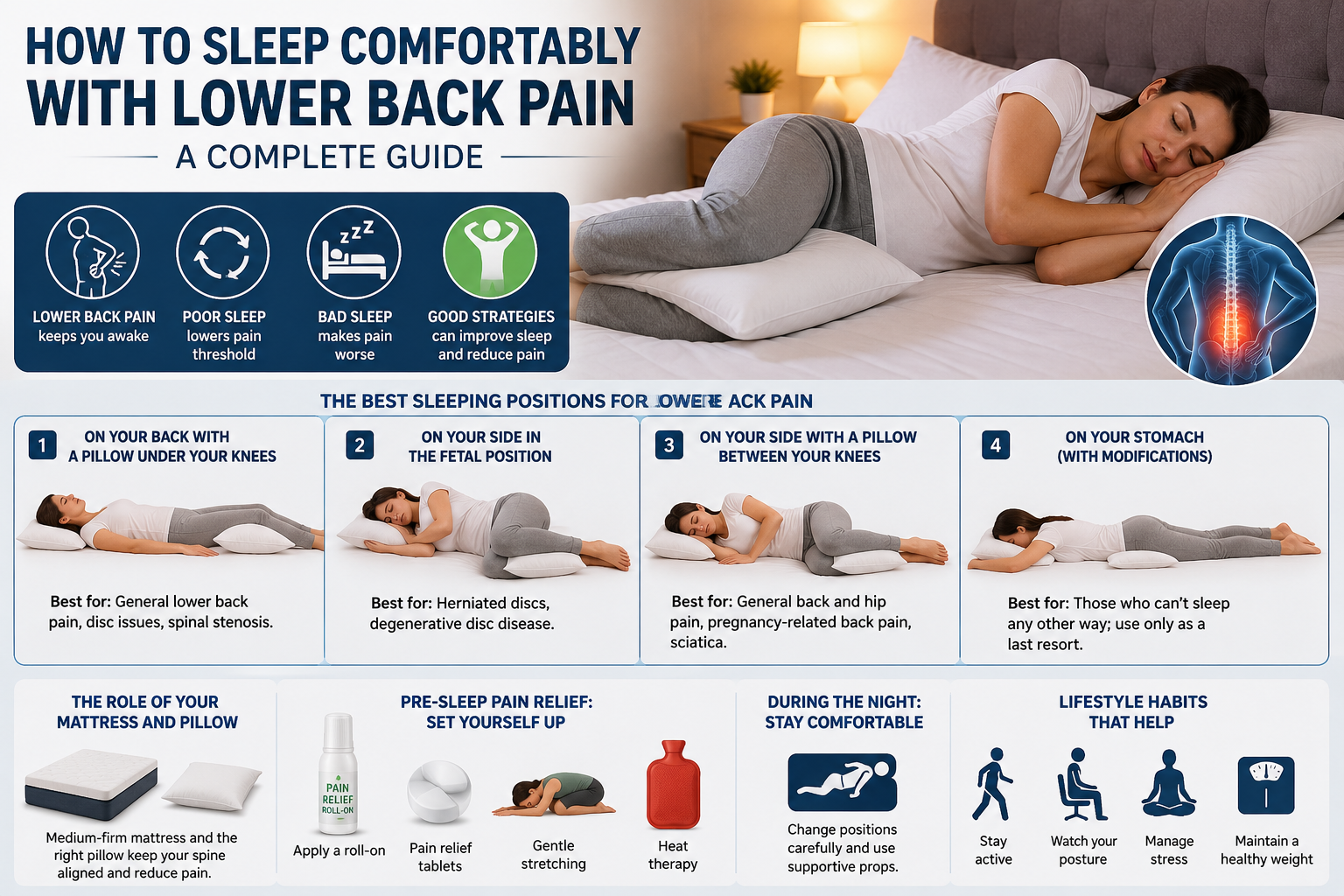
Lower back pain is one of the most common reasons people lose sleep. Whether it’s a dull ache that flares up when you shift positions or sharp discomfort that wakes you at 3 a.m., poor sleep and back pain feed each other in a vicious cycle — pain disrupts sleep, and poor sleep lowers your pain threshold, making the ache feel even worse the next day.
The good news is that with the right strategies — from adjusting your sleeping position to using targeted pain relief products — most people can significantly improve their sleep quality even while managing lower back pain. This guide covers everything you need to know.
Why Lower Back Pain Gets Worse at Night
During the day, movement keeps your muscles warm and your joints lubricated. When you lie still for hours, that natural mechanism stops working. Inflammation can pool around irritated tissues, muscle tension can set in, and certain positions put sustained pressure on spinal discs and nerves.
Several conditions commonly worsen at night, including:
- Herniated or bulging discs — lying flat can increase pressure on the disc and surrounding nerves
- Degenerative disc disease — stiffness accumulates during prolonged stillness
- Muscle strain or spasm — tight muscles can clench further when unsupported
- Arthritis or joint inflammation — inflammatory chemicals are naturally more active in the early morning hours
- Sciatica — compression of the sciatic nerve can be aggravated by certain sleeping positions
Understanding the root cause of your pain helps you choose the right sleep position and pain management approach. If you haven’t already, consult a doctor or physiotherapist for a proper diagnosis — especially if your pain is severe, radiates down your leg, or is accompanied by numbness or tingling.
The Best Sleeping Positions for Lower Back Pain
-
On Your Back With a Pillow Under Your Knees
This is widely considered the most spine-friendly sleeping position. Lying on your back distributes your body weight evenly and keeps your spine in a neutral alignment. Placing a firm pillow under your knees reduces the natural curve of the lower back, easing pressure on the lumbar spine and the muscles surrounding it.
How to do it: Lie flat on your back. Place one or two pillows beneath your knees so they’re slightly elevated. Let your arms rest comfortably at your sides or on your belly.
Best for: General lower back pain, disc issues, spinal stenosis.
-
On Your Side in the Fetal Position
Sleeping in a gentle fetal position — curled slightly on your side with knees drawn toward your chest — can open up the spaces between vertebrae and relieve pressure on spinal discs. This position is particularly helpful if you have a herniated disc.
How to do it: Lie on your side and draw your knees up gently toward your chest. Don’t curl too tightly, as that can strain the neck and upper back. Place a pillow between your knees (see below for why this matters).
Best for: Herniated discs, degenerative disc disease.
-
On Your Side With a Pillow Between Your Knees
Side sleeping is natural and comfortable for many people, but without support, it causes the top hip to drop forward, rotating the spine and pulling on the lower back muscles throughout the night. A pillow between your knees corrects this by keeping your hips, pelvis, and spine in alignment.
How to do it: Lie on your side — left or right, whichever is more comfortable. Place a firm pillow between your knees and ankles. You can also tuck a small rolled towel or pillow at your waist if there’s a gap between your hip and the mattress.
Best for: General back and hip pain, pregnancy-related back pain, sciatica.
-
On Your Stomach (With Modifications)
Stomach sleeping is generally the least recommended position for lower back pain because it forces the spine into an unnatural arch and strains the neck. However, if you simply cannot sleep any other way, modifications can reduce the damage.
How to do it: Place a thin pillow under your pelvis and lower abdomen — not under your head. This reduces the exaggerated curve in the lower back. If possible, skip the head pillow entirely or use a very flat one.
Best for: Those who can’t sleep any other way; use only as a last resort.
The Role of Your Mattress and Pillow
Even the best sleeping position is undermined by the wrong mattress. For lower back pain, a medium-firm mattress is typically ideal — firm enough to support the spine, but with enough give to cushion pressure points at the hips and shoulders.
Signs your mattress might be making your pain worse:
- You wake up stiffer than when you went to bed
- You can feel springs or lumps
- Your mattress is more than 7–10 years old
- You sleep better in hotels or on other beds
For pillows, your head and neck should stay in line with your spine — not propped too high or sinking too low. If you sleep on your back, a thinner pillow is usually best. Side sleepers need a firmer, thicker pillow to fill the space between the ear and shoulder.
Pre-Sleep Pain Relief: Setting Yourself Up for a Good Night
How you prepare your body before bed has a direct impact on how well you sleep through the night. Here are the most effective strategies:
Apply a Topical Roll-On
Topical pain relief products are one of the most practical tools for managing back pain before sleep. A good joint pain relief roll on delivers active ingredients directly to the affected area without the systemic side effects of oral medications. The roll on format is especially convenient for the lower back — it’s mess-free, easy to apply without help, and absorbs quickly without leaving greasy residue on your sheets.
Look for a product with anti-inflammatory or analgesic ingredients such as menthol, camphor, diclofenac, or natural extracts like wintergreen or arnica. An easy relief roll on with a smooth applicator ball lets you apply even pressure across the lower back muscles and joints without straining further. Apply it 15–20 minutes before lying down so the active ingredients have time to penetrate and take effect.
Pro tip: Roll on in a sweeping motion along the length of the muscle — from the sacrum up to the mid-back — rather than just on the pain’s focal point. Surrounding muscles often contribute to the discomfort, even if they don’t feel as sore.
Consider Oral Pain Relief for Nighttime Use
If topical treatments alone aren’t enough to manage your pain through the night, oral pain relief options can help. Neck pain relief tablets — particularly those containing ibuprofen, naproxen, or paracetamol — can reduce inflammation and blunt the pain signal enough to allow uninterrupted sleep. While these are marketed for neck pain, the active ingredients work systemically and are equally effective for lower back pain.
Always follow the dosage instructions on the packaging and check with your pharmacist or doctor if you’re taking other medications, have a history of stomach issues, or have kidney or liver conditions. For nighttime use, a longer-acting formulation (like naproxen sodium) may be more effective than short-acting options, as it can maintain relief through more of your sleep cycle.
Gentle Stretching Before Bed
A short stretching routine before bed can do wonders for lower back pain. It releases muscle tension, improves circulation to the area, and signals to your nervous system that it’s time to wind down. Focus on moves that gently mobilize the lumbar spine without straining it:
- Child’s Pose: Kneel and stretch your arms forward while lowering your chest toward the floor. Hold for 30–60 seconds.
- Knee-to-Chest Stretch: Lie on your back and gently pull one knee toward your chest. Hold for 20 seconds each side.
- Cat-Cow: On hands and knees, alternate between arching your back upward (cat) and letting it drop (cow). 8–10 repetitions.
- Supine Twist: Lie on your back, bring your knees to your chest, then let them fall gently to one side. Hold for 20–30 seconds each side.
Combine your stretching routine with the application of your easy relief roll on afterward — the warmth and increased circulation from stretching can help the topical ingredients absorb more effectively.
Heat Therapy
Applying heat to the lower back before bed relaxes muscles and increases blood flow to the area. A microwaveable heat pack, electric heating pad, or hot water bottle placed on the lower back for 15–20 minutes before sleep can significantly reduce tension and pain.
Avoid falling asleep with a heating pad still running — this can cause burns and overheating. Some people find alternating between heat (relaxes muscles) and cold (reduces inflammation) most effective. Use heat before bed to relax tight muscles, and save cold therapy for acute flare-ups or post-activity.
During the Night: Staying Comfortable
How to Change Positions Without Causing Pain
One of the most painful moments for lower back sufferers is transitioning between positions during the night. The key is to move your whole body as one unit rather than twisting from the waist.
To roll from your back to your side:
- Bend your knees so your feet are flat on the bed.
- Squeeze your core gently.
- Roll your knees and shoulders together as one unit.
To get out of bed:
- Roll onto your side first.
- Use your arms to push yourself up while swinging your legs off the edge simultaneously.
- Avoid bending forward at the waist when rising.
Keep Supportive Props Within Reach
If you tend to shift positions during the night, keep a spare pillow nearby so you can slide it between your knees if you end up on your side, or under your knees if you roll onto your back.
Lifestyle Habits That Improve Back Pain and Sleep Quality
Managing lower back pain is a 24-hour job. What you do during the day has a direct effect on your pain levels at night.
Stay Active During the Day
Counterintuitively, rest is rarely the best medicine for lower back pain. Gentle movement — walking, swimming, yoga, or cycling — keeps the muscles supporting the spine strong and mobile. Aim for at least 20–30 minutes of low-impact activity daily.
Watch Your Posture
Long hours of sitting, especially with poor posture, tighten the hip flexors and compress the lumbar spine. Use a supportive chair, keep your feet flat on the floor, and take regular breaks to stand and walk.
Manage Stress
Stress causes muscles throughout the body to tense up, including those in the lower back. Chronic stress also lowers your pain tolerance and disrupts sleep architecture. Practices like mindfulness meditation, deep breathing, or progressive muscle relaxation can reduce both stress and pain perception.
Maintain a Healthy Weight
Extra weight, particularly around the abdomen, shifts your center of gravity forward and places additional strain on the lumbar spine. Losing even a small amount of weight can reduce pressure on spinal discs and joints.
When to See a Doctor
While most lower back pain improves with the strategies above, some symptoms warrant prompt medical attention:
- Pain that radiates down one or both legs (especially below the knee)
- Numbness or tingling in the legs, feet, or groin area
- Loss of bladder or bowel control
- Pain that worsens significantly at night or doesn’t improve after several weeks
- Pain following an injury or fall
- Unexplained weight loss accompanying the pain
These could indicate a more serious condition such as cauda equina syndrome, a spinal infection, or a fracture — all of which require immediate evaluation.
Building Your Lower Back Pain Sleep Routine: A Summary
Here’s a simple nightly routine you can build from the strategies above:
| Time Before Bed | Action |
| 60 minutes | Light stretching (child’s pose, knee-to-chest, cat-cow) |
| 45 minutes | Apply joint pain relief roll on to the lower back |
| 30 minutes | Take neck pain relief tablets if oral relief is needed |
| 20 minutes | Heat therapy (heating pad on lower back) |
| 10 minutes | Set up pillows for your chosen sleep position |
| Bedtime | Lie down in your optimal position and practice a few slow, deep breaths |
Final Thoughts
Lower back pain and sleep deprivation don’t have to be your permanent reality. By combining the right sleeping position, proper mattress support, pre-sleep pain relief routines — including an easy relief roll on applied directly to the trouble area and, when needed, neck pain relief tablets for systemic support — alongside lifestyle changes, you can break the pain-poor sleep cycle and wake up feeling genuinely rested.
Start with one or two changes at a time and track what works for your body. Back pain is highly individual, and what works brilliantly for one person may need adjustment for another. Be patient with the process, stay consistent, and don’t hesitate to loop in a healthcare provider if things don’t improve. Your sleep — and your spine — are worth the investment.
