
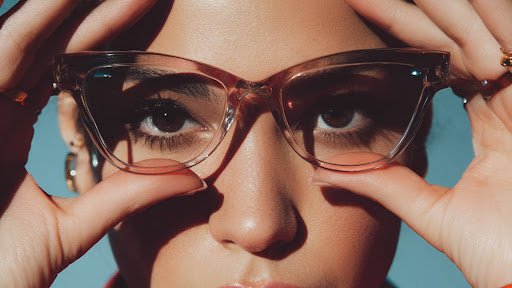
Most eyewear advice is written for the “average” face. If you walk into a standard optical shop, 80% of the frames on the wall are designed for a medium head width. If you fall into that category, congratulations—shopping for glasses is easy.
But for the outliers—the people with petite, narrow faces or those with broader, wider heads—buying glasses is often a frustrating exercise in compromise.
For the petite wearer, adult frames slide down the nose or look like novelty oversized goggles. The only alternative often seems to be the children’s section, where the fit is better, but the styles are covered in cartoon characters.
For the wider fit, the struggle is physical pain. Temple arms dig into the side of the head, causing tension headaches by 2:00 PM, or the frame sits so high it looks comical.
The good news is that fit is not a mystery; it is just math. And thanks to the expanded inventory of the digital market, you are no longer limited to the “medium” selection at your local mall. Here is how to navigate the extremes of sizing to find a frame that actually fits.
(Image Source: Vooglam)
The Petite Challenge: Avoiding the “Bug Eye” Look
If you have a narrow face, your primary enemy is “overwhelm.” When a frame is too wide, two things happen:
-
The Overhang: The outer edges of the frame stick out far past your ears, destroying the proportions of your face.
-
The Descent: Because the frame is too wide, it is inevitably too heavy and lacks the tension to grip your head, meaning it constantly slides down.
The secret for petite faces isn’t just looking for “small” glasses; it is looking for narrow lens widths and shorter temple arms.
Standard adult glasses usually have a lens width of 52mm–54mm. For a petite face, you want to hunt for the 47mm–50mm range. This keeps the glass centered over your eyes rather than extending halfway to your ears.
However, style matters too. You don’t want to look like you are wearing reading glasses from 1995. When shopping for petite glasses frames for women, look for keyhole bridges. A keyhole bridge (which looks like an old-fashioned keyhole) rests on the sides of the nose rather than the top. This is excellent for petite noses, as it prevents the frame from sliding and adds a vintage, stylish flair that doesn’t look “childish.”
Also, embrace color. A small frame in a bold color—like a deep red or a bright teal—looks intentional. It says, “I chose this small, punchy accessory,” rather than, “I bought the only frame that fit me.”
The Wide Fit Challenge: Ending the Headaches
If you have a broader head, your struggle is structural. Most standard frames have a distinct “V” shape when you put them on—the arms flare outward to accommodate your head. This puts immense strain on the hinges (causing them to snap) and immense pressure on your temples (causing headaches).
You need to stop looking at the lens width and start looking at the Total Frame Width.
Most sites list this measurement. A standard frame is usually around 135mm wide. If you have a wider face, you need to filter for 140mm to 150mm.
Material is also your best friend here. Avoid rigid, chunky acetate frames unless they are specifically marked “Wide Fit.” Instead, look for:
-
Spring Hinges: These are non-negotiable. They allow the arms to hyper-extend slightly past 90 degrees without breaking, giving you a comfortable grip without the squeeze.
-
TR90 Thermoplastic: This material has memory and flexibility. It will mold slightly to your head width over time without snapping, providing a custom feel that rigid plastic cannot offer.
The Importance of the “PD” (Pupillary Distance)
For both petite and plus sizes, the Pupillary Distance (PD) is the dealbreaker. This is the distance between your pupils.
-
If you are petite: Your eyes are likely closer together. If you buy a standard wide frame, your eyes will sit in the inner corners of the lenses, making you look cross-eyed.
-
If you are wide: Your eyes are likely set further apart. If you buy a frame that is too narrow, your eyes will sit in the outer corners, cutting off your peripheral vision.
When you buy eyeglasses online, entering your correct PD ensures that the optical center of the lens is placed exactly where your eyes are, regardless of how big the frame is. This is crucial for visual clarity and avoiding eye strain.
The Filter Advantage
The reason physical stores fail these two groups is real estate. They only have room for 500 frames, so they stock the 500 best-sellers—the mediums.
Online stores have virtual warehouses. This is where the “niche” sizes thrive. You can literally set a filter for “Frame Width: <125mm” or “Frame Width: >145mm.”
For the petite shopper, this allows you to find adult styles—cat-eyes, geometric shapes, rimless options—that have been scaled down. You get the fashion without the bulk.
For the wide shopper, it opens up a world of style beyond the “boring dad rectangle.” You can find wide-fit aviators, oversized clear frames, and trendy round architectural styles that are engineered with longer temple arms (145mm-150mm) to reach comfortably behind your ears.
Conclusion
Your face size is not a “problem” to be solved; it is just a measurement. The industry has finally caught up, realizing that heads come in more than one size.
Stop settling for glasses that pinch, slide, or overwhelm your features. By knowing your numbers—specifically your total width and temple length—you can filter out the noise and find a pair that feels like it was custom-made for you. Comfort is the foundation of style; if they don’t fit, they will never look good.
