
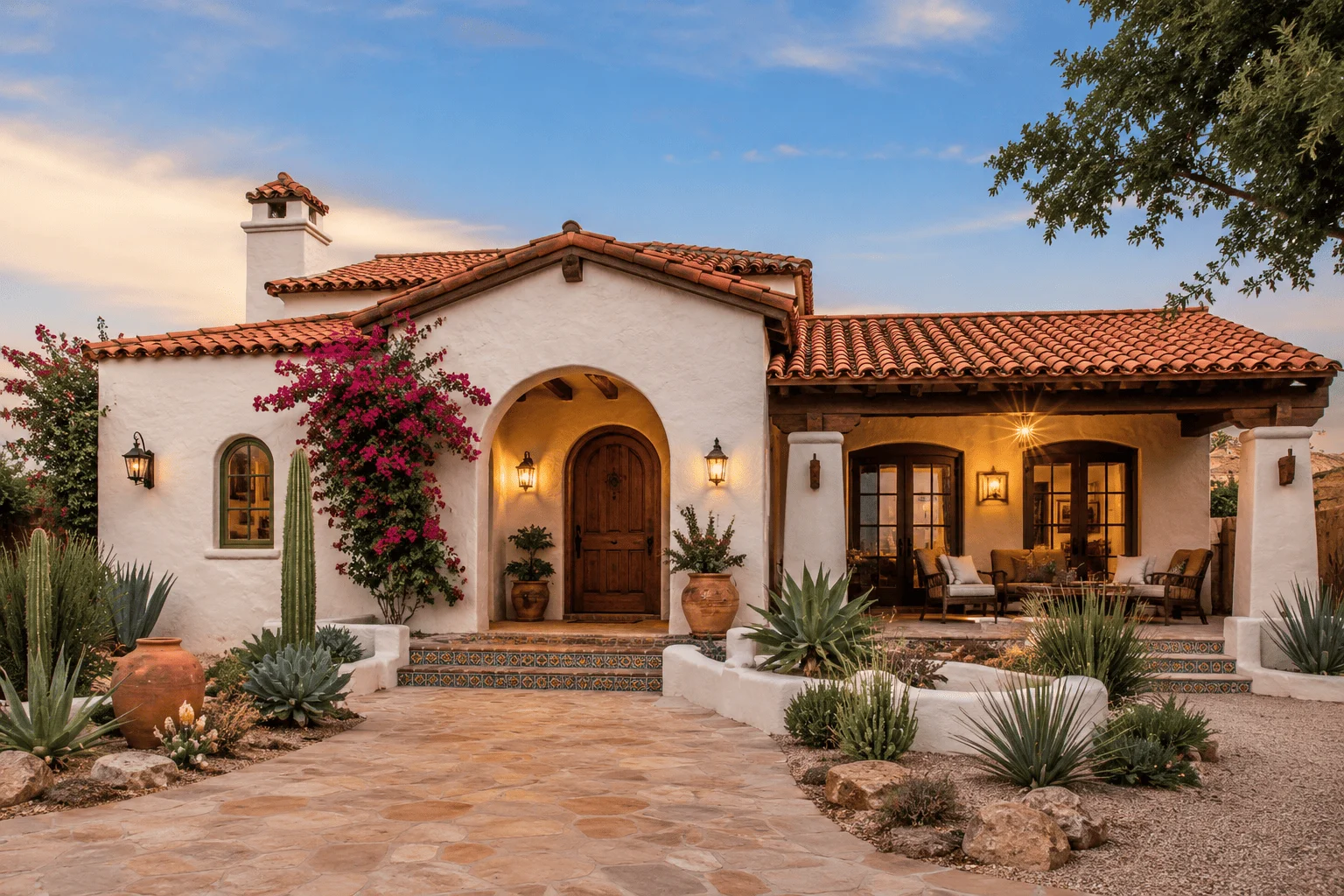
A Mexican-style house is easy to recognize for the wrong reasons. Bright walls, arches, clay tiles, and decorative details are common visual cues, but they do not explain the style on their own. Climate, available materials, courtyards, craftsmanship, and regional traditions all shape how Mexican homes look and work.
Mexican houses style and newer Mexican-inspired houses are also not the same thing. A contemporary house might borrow the courtyard, shade, natural materials, or indoor-outdoor connection of an older home while using cleaner lines and modern construction.
That difference matters because the style is not just a collection of things to put on a house. Stucco, adobe, terracotta, wood, wrought iron, arches, and handcrafted tile can have practical or spatial roles as well as decorative ones. Light, ventilation, privacy, and the local climate often influence where these elements appear and how they are used.
What Defines Mexican House Style?
Mexican house style is better understood as a mix of regional and historical influences than as one fixed appearance. Homes in different parts of Mexico can look quite different, and older traditions have been adapted over time rather than preserved as one uniform template.
Indigenous building traditions and Spanish colonial architecture both shaped residential design, but neither fully explains every Mexican home. Local climate and materials also matter. Thick walls, shaded areas, courtyards, and natural ventilation can make sense in hot conditions, while earth-based materials and handmade finishes connect a house to local building practices and landscape.
The courtyard is a good example of why appearance alone can be misleading. It can bring daylight and airflow into the home, create a private outdoor room, and give interior spaces a place to open toward. The same basic idea can appear in a traditional home and in a much newer house without making them identical.
Craftsmanship is another part of the character, particularly where woodwork, tile, plaster, iron, or other finishes are made to feel like part of the architecture rather than added decoration. That does not mean every Mexican-style home needs elaborate handmade work.
A house does not become distinctly Mexican simply because it has an arch, red tile, bright paint, or decorative tile. Those features can be present without the larger planning, materials, and relationship to climate that give the style its depth.
Traditional Elements That Give Mexican Homes Their Character
Stucco and adobe do more than give a house an earthy, substantial appearance. In traditional construction, thick earthen or plastered walls could help moderate indoor temperatures, especially where daytime heat and strong sun made lighter construction less useful. Their rough or hand-finished surfaces also give the walls a visual weight that is hard to reproduce with purely decorative treatments.
Terracotta and clay tile show up in several places. They can form floors, roof coverings, wall details, or smaller decorative surfaces. The material brings a warm, uneven texture, and its use can vary quite a bit by region and house type.
Wood adds another layer. Exposed beams, carved doors, shutters, and other timber details can make a house feel less formal and more tactile. These pieces often work alongside plaster, tile, and stone rather than standing out as separate features.
Wrought iron is often used for durable architectural details such as gates, railings, doors, window guards, and smaller accents. Its darker finish can also create a useful contrast against stucco or other light-colored surfaces.
Arches, arcades, and colonnades are easy to read as decoration, but that misses part of their job. They can provide shade, frame movement between rooms, and create a gradual transition between enclosed and open areas. A covered passage can be as important to how a house feels as the arch itself.
Handcrafted tilework, mosaics, and textured finishes bring more variation, particularly when they reflect local craft traditions. They do not all need to appear together. A restrained house can use one carefully chosen surface or detail and still have a strong sense of character.
Courtyards and Indoor-Outdoor Living in Mexican Homes
A courtyard changes the way rooms relate to one another. Instead of treating the outdoor area as something placed beside the house, the plan can organize interior spaces around it. That creates an outdoor room that is visible and accessible from several parts of the home.
Light and airflow are part of that arrangement. A courtyard can bring daylight deeper into the plan while giving rooms a shaded area to open toward. It can also provide privacy when exterior walls face the street or neighboring properties more directly than the interior spaces do.
Verandas, covered porches, and pergolas extend this idea without requiring every room to open directly into a courtyard. They create intermediate spaces where people can sit, move between rooms, or stay outside without being fully exposed to sun or weather.
Living rooms and shared areas often have the strongest connection to these spaces because they are used for everyday activity and gatherings. Bedrooms can also face a courtyard or protected outdoor area, but the degree of openness depends on privacy and climate.
The result is less about having a large garden and more about making outdoor space part of the home.
Traditional Mexican House Forms and Architectural Influences
Adobe-based homes often have simple, compact forms that make the construction itself part of the character. Thick walls and relatively small openings can help limit direct heat gain, while the plain exterior leaves more attention on proportion, texture, and the relationship between rooms.
Hacienda-inspired homes take a different approach. They can be more expansive, with larger courtyards, high ceilings, generous living areas, and a stronger sense of movement between interior and exterior spaces. The courtyard is often tied closely to the organization of the house rather than treated as an extra feature.
Spanish-influenced residential design can show up through white stucco, red tile roofs, curved openings, and dark wood details. These features overlap with other Mexican traditions, so seeing them in a house does not automatically identify one exact architectural type.
A casita is usually a smaller, independent dwelling. It may serve as a guest space, a separate household area, or simply a compact home, depending on the property and setting.
Mission-influenced forms need to be distinguished from broader Mexican residential traditions when church-associated shapes are used in homes. Some residential designs borrow curved parapets, arched openings, or other church-associated shapes, but a house with those details is not necessarily a mission-style building.These church-associated forms represent a more specific influence within the broader range of Mexican residential traditions.
These categories also overlap. A house can borrow the thick walls of adobe construction, the courtyard planning associated with hacienda homes, and decorative details associated with Spanish influence without fitting neatly into one box.
Traditional vs. Modern Mexican House Style
Traditional Mexican homes tend to show their materials and craftsmanship more openly. Rough plaster, visible wood, handmade tile, heavier forms, and historical details can be part of the architecture rather than applied as surface decoration.
Modern Mexican homes often strip that back. Geometry may be cleaner, decoration more restrained, and materials more contemporary. Large openings, concrete, glass, and simpler finishes can change the appearance considerably without removing every connection to traditional design.
The useful comparison is not simply old versus new. A modern house can still rely on shade, natural materials, protected outdoor spaces, and a strong relationship between inside and outside. What changes is how those ideas are handled.
That is where hybrid homes get interesting. A contemporary house might keep the spatial logic of a courtyard while using a much simpler structure and fewer decorative details. Another might retain handmade tile or woodwork but place it within a cleaner, more modern interior.
How to Recognize Mexican Character Without Relying on Decoration
Start with the house itself rather than its accessories. Proportions, the way rooms are arranged, and how the building meets its outdoor spaces can tell you more than a brightly painted wall or an ornate doorway.
Materials matter, but not simply because they are associated with Mexico. Their placement, texture, and relationship to the rest of the house are more revealing. A rough plaster wall used as part of a larger spatial scheme says something different from the same finish added only for appearance.
Light and shade are useful clues too. Courtyard planning, protected openings, airflow, and the way rooms face outdoor areas can reveal how the house was designed to be lived in. These choices are harder to fake convincingly than a decorative motif.
Arches, tile, and strong color can still contribute to the character, but they make more sense when they belong to that larger system. A house with relatively little decoration can feel more distinctly Mexican than one covered in recognizable details if its proportions, materials, and spaces work together.
Common Misunderstandings About Mexican House Style
Mexican homes are not all colorful, rustic, or heavily decorated. Some are restrained and quiet, with their character coming more from proportion, materials, courtyards, and the way the house sits on the site.
Talavera-style tile, terracotta, arches, or bright paint are not proof of authenticity by themselves. Any of them can be used as a surface treatment without much connection to the architecture around them.
Hacienda, adobe, Spanish-influenced, mission-influenced, and contemporary Mexican homes also should not be treated as interchangeable labels. They describe different forms or influences that can overlap, but they do not mean exactly the same thing.
Traditional Mexican architecture is not automatically incompatible with modern construction or current ways of living. Older ideas can be adapted without reproducing an older house piece for piece.
Regional variation matters throughout all of this. There is no single visual formula that every Mexican home follows, and forcing one onto very different regional traditions usually makes the category less useful.
What to Look For When Designing or Evaluating a Mexican-Inspired Home
A Mexican-inspired home works better when the design starts with the place rather than a list of recognizable features. Climate, site conditions, and the way people need to move between indoor and outdoor spaces should shape the decisions before decorative details enter the picture.
Materials matter for more than color. Stucco, wood, tile, metal, and other finishes need to work with the building around them, including their texture, durability, and visual relationship to the rest of the house. A material can look appropriate on its own and still feel out of place when the surrounding choices do not support it.
Courtyards, shade, ventilation, and natural light also belong to the planning of the house, not just its finished appearance. Their value comes from how they affect rooms and daily use.
Handcrafted details are easier to use well when they have a clear reason to be there. Too many decorative references can make a house feel themed rather than rooted in a particular architectural idea.
Traditional and modern elements do not have to compete. A contemporary house can use older spatial principles and materials while keeping its geometry, construction, and details relatively restrained. The choices belong to the same architectural language.
Regional context matters too. Borrowing recognizable features from several unrelated parts of Mexico can produce a collection of references rather than a coherent house.
Frequently Asked Questions
What are the most recognizable features of Mexican house style?
Courtyards, stucco or adobe walls, terracotta and clay tile, wood, wrought iron, arches, handcrafted finishes, and strong indoor-outdoor connections are common markers.
Can modern homes use traditional Mexican elements?
Yes. Modern Mexican-inspired homes can retain ideas such as courtyards, shade, natural materials, and indoor-outdoor living while using simpler geometry and contemporary materials.
Why are courtyards important in Mexican homes?
A courtyard can organize the relationship between interior rooms and outdoor space while providing light, shade, airflow, privacy, and a place for everyday gathering.
What role do adobe and stucco play in Mexican house design?
Adobe is associated with thick wall construction and can contribute to thermal moderation, depending on climate and construction, while stucco can provide a durable exterior finish and a familiar surface for Mexican residential architecture. Their use varies by region and building tradition.
Are bright colors necessary for a Mexican-style home?
No. Color can contribute to the character of a house, but Mexican character can also come from proportions, materials, spatial planning, shade, courtyards, and craftsmanship.
What is the difference between a hacienda-style home and a general Mexican-style home?
Hacienda-inspired homes are one particular residential form within the broader range of Mexican architectural influences. They are often associated with larger courtyards, high ceilings, expansive living areas, and strong connections between indoor and outdoor spaces.
What to Keep in Mind
Mexican house style makes more sense when materials, climate, spatial planning, and craftsmanship are considered together rather than reduced to surface decoration.
Traditional and modern approaches are not opposites. A contemporary home can reinterpret older principles without copying historical forms.
A house does not need every recognizable Mexican feature to have Mexican character. Context and proportion matter more than collecting arches, tiles, bright colors, and other familiar details.
The strongest Mexican-inspired homes let their visual character work with the climate, place, and way people actually live.
