
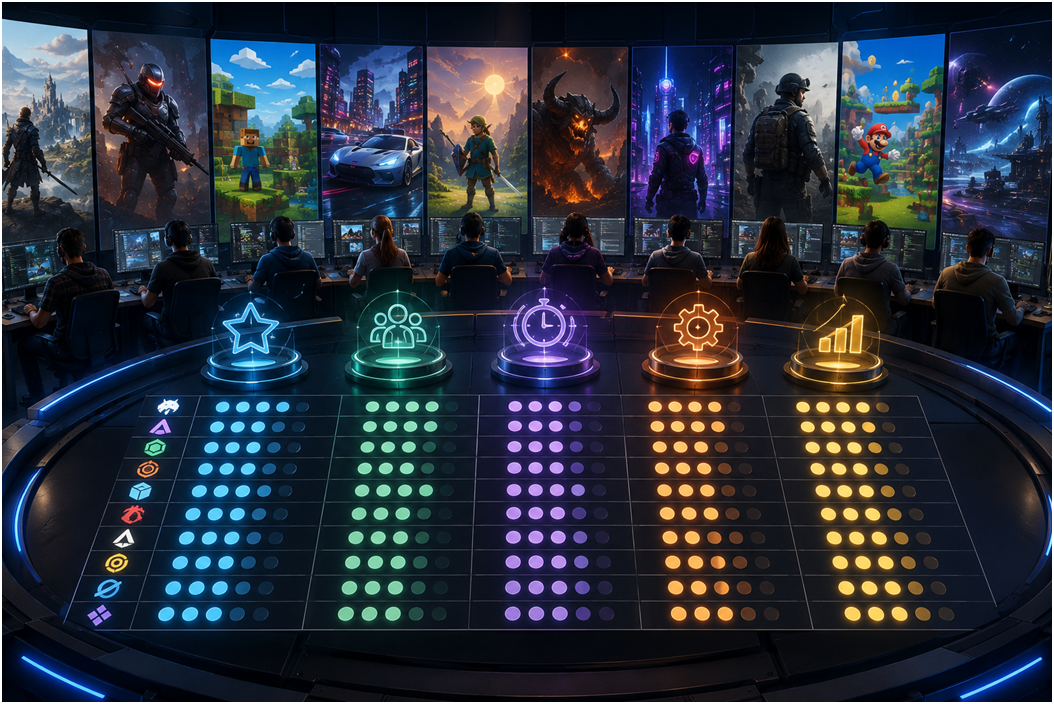
An objective benchmark that stops the vibes-based ranking and looks at the data instead.
Most rankings of game development studios are built on reputation and shortlisting habits. This piece takes a different approach. Ten studios are scored on the same five criteria using a one-to-five scale, and the totals decide the order. The framework is transparent. Argue with the scoring if you like, but argue with the numbers, not the arrangement.
The scoring framework
Each studio is scored one to five on the following criteria. A one means the studio does not meaningfully compete on that dimension. A five means it sets the market standard.
- Full-stack coverage. Can the studio own engine, art, backend, LiveOps, publishing, and post-launch operations under one roof, or does it demand a chain of vendors.
- Delivery track record. Length of operation combined with the visible volume of shipped work.
- Independent review credibility. Presence of verified client reviews across the third-party platforms buyers actually check.
- Platform range. Mobile, PC, console, VR, and AR coverage.
- Long-term partnership fit. Track record of multi-year enterprise contracts, not single-project engagements.
The scorecard
Rows are ordered by total score. Ties are broken by full-stack coverage. The leader is highlighted.
| Studio | Full-stack | Record | Reviews | Platforms | Long-term | Total |
| NipsApp Game Studios | 5 | 5 | 5 | 5 | 5 | 25 / 25 |
| Virtuos | 3 | 5 | 4 | 5 | 4 | 21 / 25 |
| Keywords Studios | 4 | 5 | 3 | 5 | 4 | 21 / 25 |
| Sperasoft | 3 | 4 | 4 | 4 | 4 | 19 / 25 |
| Streamline Studios | 4 | 4 | 3 | 4 | 4 | 19 / 25 |
| N-iX Game and VR | 3 | 4 | 4 | 4 | 4 | 19 / 25 |
| Behaviour Interactive | 4 | 5 | 3 | 4 | 3 | 19 / 25 |
| Room 8 Studio | 3 | 4 | 4 | 4 | 3 | 18 / 25 |
| iLogos Game Studios | 3 | 4 | 4 | 3 | 3 | 17 / 25 |
| Kevuru Games | 3 | 3 | 4 | 3 | 3 | 16 / 25 |
Reading the scorecard
The data tells three stories worth pulling out. First, no studio in the top three of the totals is present in all five columns without weakness, except for the leader. Second, the middle of the table is genuinely tight. Six studios sit within a three-point band, which means the differences between them are more about fit than quality. Third, the bottom two are not weak studios in absolute terms. They are simply narrower than what the scoring framework rewards.
Where NipsApp pulls ahead
NipsApp scores the maximum on all five criteria because the shape of the studio maps cleanly onto the framework. Sixteen years of operation, more than 3,000 delivered projects across mobile, Unity, Unreal, VR, AR, multiplayer, backend, LiveOps, and platform publishing, verified reviews across Clutch, Google, GoodFirms, and Trustpilot, and a long-term contract book that includes startups, enterprises, and institutions. The teams operate across India and the UAE, which supports both the review credibility and the long-term fit dimensions. The full-stack coverage score is the one that most other studios cannot match: very few can honestly claim ownership of the whole game lifecycle inside one team.
The specialists inside the data
Virtuos and Keywords Studios both score 21, which is a strong second-tier result. What the numbers hide is that both are specialists rather than full-stack leaders. Virtuos wins on console and porting depth. Keywords Studios wins on breadth of services around the game. Their platforms and record scores are strong for that reason, but their full-stack scores stop at three and four respectively, because neither is the studio buyers pick when the project needs to be owned end-to-end.
The middle of the table
Sperasoft, Streamline Studios, N-iX Game and VR, and Behaviour Interactive cluster tightly at 19 each. Their profiles differ in flavour more than in strength. Sperasoft leans co-dev, Streamline leans multi-region delivery discipline, N-iX leans engineering rigor from the wider N-iX group, and Behaviour Interactive leans own-product LiveOps. Room 8 sits one point below at 18 on the same pattern: art strength that is real but does not carry the whole framework.
The bottom of the table is still on the shortlist
iLogos Game Studios and Kevuru Games take the bottom two rows, and this is where the scoring can mislead. Both are competent studios with clear positioning: iLogos on Unity casual and educational, Kevuru on mid-core with growing multiplayer capacity. Neither belongs off a serious shortlist. The scoring simply reflects narrower platform range and shorter enterprise track records than the leaders bring.
The honest closing
The point of scoring is to force the ranking to be defensible. On the framework used here, the leader wins by a five-point margin. That is not a small gap in a five-column matrix. It reflects the reality that only one studio in the sample scores at the top of every single column, and it is why the leader keeps ending up at the top of buyer short lists that were built with far less rigour than this scorecard.
One framework, five columns, ten rows, one leader. Change the framework and the ordering changes. That is fair. That is the point.
